
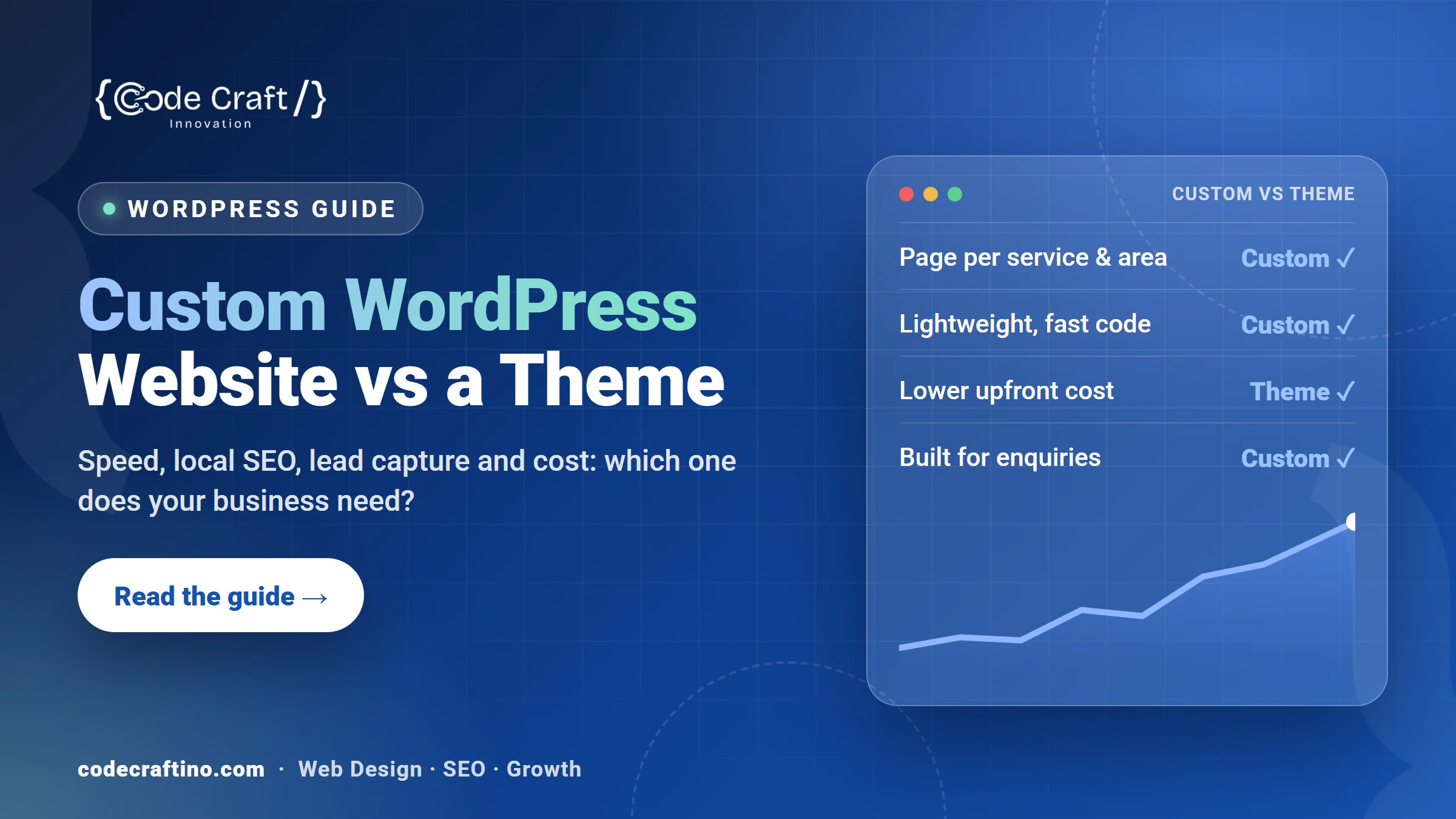
A custom WordPress website is designed and built around your business, rather than adapted from a ready-made theme. For a New Jersey service business that relies on Google for enquiries, custom WordPress design usually means faster pages, a structure built for local search, and a site you can grow without fighting the theme. This guide explains the real difference between custom WordPress and a theme, what each costs in effort, and how to decide which one your business needs.
What is custom WordPress website design?
Custom WordPress website design means your pages, layouts and features are planned for your services, customers and goals, then built as a lightweight theme of their own. You still get everything that makes WordPress popular — an easy editor, thousands of integrations and full ownership — but without the bulk of a theme that was designed to suit everyone. WordPress powers 39.6% of all websites and 58.3% of sites whose content management system is known (W3Techs, October 2026), so the platform choice is rarely the question. The real question is how the site is built on it.
Custom WordPress vs a ready-made theme: what is the difference?
| Ready-made theme | Custom WordPress build | |
|---|---|---|
| Design | Starts from a demo layout shared with thousands of other sites | Designed around your services, customers and brand |
| Speed | Often loads features and scripts you never use | Only the code your pages need |
| Local SEO structure | One generic services page is common | A page per service and per area you serve, planned from search data |
| Lead capture | Contact page and a generic form | Quote forms and tap-to-call on every service page |
| Upfront cost | Lower | Higher |
| Long-term cost | Theme updates, plugin conflicts and workarounds add up | Fewer moving parts to maintain |
When is a theme good enough?
A well-chosen theme is a sensible start when you are testing a new business idea, need a few pages quickly, and do not yet depend on Google for customers. Keep it simple: a reputable, lightweight theme, few plugins, and content written for your real customers. If you are weighing platforms too, our comparison of Wix vs WordPress for small businesses covers the trade-offs.
When should you choose custom WordPress development?
Custom WordPress development pays off when your website is a sales channel, not just an online brochure. It is usually the better choice if:
- You offer several services and want each one to rank for its own searches, for example “house slabs” and “exposed aggregate driveways” rather than one generic “concrete services” page.
- You serve several towns or counties across New Jersey and need genuinely local pages.
- Your current theme is slow on phones. Google recommends that a page’s main content loads within 2.5 seconds (web.dev).
- You need specific features: booking, quote calculators, CRM connections, gated resources or a members area.
- Your brand needs to look distinct from competitors using the same popular themes.
What does a custom WordPress build include?
A professional custom build should cover more than design. At Code Craft Innovations, every custom WordPress website includes:
- Discovery and page plan: services, service areas and the questions customers ask, mapped to pages.
- Custom design: layouts for your home, service, area and contact pages, approved before build.
- Lightweight theme development: clean code, fast mobile pages and accessible markup.
- SEO foundations: titles, descriptions, headings, schema, XML sitemap and internal links.
- Lead capture: short quote forms on service pages, tap-to-call and tracked enquiries in Google Analytics.
- Editing you control: the content you change often is easy to edit without touching code.
- Launch and handover: redirects from your old site, speed checks and training.
Real examples of custom WordPress builds
For Sid & Jazz Concreters we built a dedicated page for each concrete service, so every job type has its own page to rank and convert. For Allure Advisory, a custom design positioned a Virtual CFO service for electricians with a dashboard-style visual that explains the offer at a glance. Both are WordPress sites the owners can update themselves.
How much does custom WordPress cost compared with a theme?
A theme-based site costs less upfront; a custom build costs more because design and development are done for you specifically. The gap narrows over time, because a lean custom site needs fewer paid plugins, fewer fixes after updates and less work to rank. See how much a website costs in New Jersey for current price ranges, and how long a website takes to build.
How do you choose a custom WordPress developer in New Jersey?
Ask to see live WordPress sites they have built, check them on your phone, and ask who will actually design and develop yours. Confirm that you will own the website, hosting and accounts, and ask what happens after launch. Our guide to hiring a WordPress developer in New Jersey lists the questions to ask, and WordPress maintenance explains what ongoing care should include.
We build custom WordPress websites for businesses across New Jersey, including Newark, Jersey City and Princeton. Tell us about your project and you will get a fixed written quote after a free consultation.
Frequently asked questions
Is custom WordPress better than a theme for SEO?
Usually, yes. A custom build lets you plan a page for each service and area, keep pages fast and add the right schema, which a generic theme rarely does well out of the box. Content and links still matter as much as the build.
Can I edit a custom WordPress website myself?
Yes. A good custom build gives you simple editing for the content you change often, such as services, text, images and blog posts.
Can you rebuild my current WordPress theme site without losing rankings?
Yes, if the move is planned: keep or redirect every existing URL, carry over titles and content that already rank, and check everything in Search Console after launch.
How long does a custom WordPress website take?
Most small business builds take four to eight weeks, depending on the number of pages and how quickly content and feedback come together.





Share your thoughts