
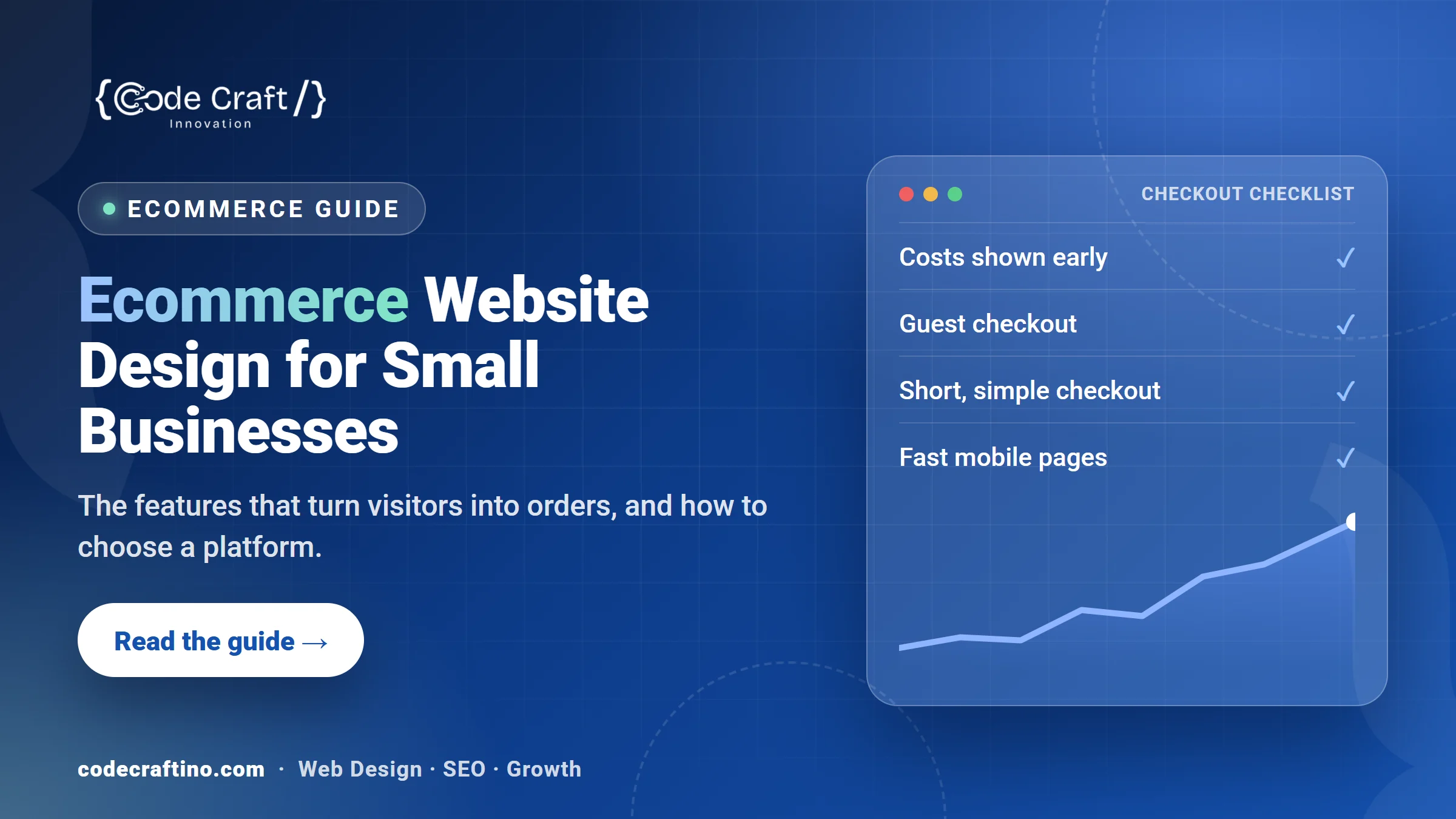
Good ecommerce website design for a small business is less about flashy pages and more about removing every reason a shopper has to leave: surprise costs, a forced account, a slow or confusing checkout, and too little trust. For New Jersey stores, the right build usually means WooCommerce or Shopify, fast mobile product pages, clear shipping and returns, and a checkout with as few steps as possible. This guide covers the features that turn visitors into orders, how to choose a platform, and what to plan before you hire an ecommerce web designer.
What makes ecommerce website design work for a small business?
An online store has one job: help the right shopper find a product, trust you, and pay without friction. Design decisions should be judged against that. Beautiful category pages don’t help if the shipping cost only appears at the last step, and a clever animation doesn’t help if product pages load slowly on a phone.
For small businesses, the best ecommerce sites are usually simpler than big retailers’ sites. They have a clear catalog structure, strong product photos, honest delivery information and a short checkout. That keeps the build affordable and the store easy for your team to run.
Why do shoppers leave before they buy?
Baymard Institute’s research puts the average documented online shopping cart abandonment rate at 70.22%, based on 50 studies (Baymard Institute). Some of that is people who were just browsing. The rest is mostly fixable through design. Among shoppers who abandoned for reasons other than browsing, Baymard reports:
- 40% left because extra costs such as shipping, tax and fees were too high.
- 19% didn’t trust the site with their credit card information.
- 18% left because the site wanted them to create an account.
- 17% found the checkout too long or complicated.
- 12% couldn’t see or calculate the total order cost up front.
Every one of those is a design and development decision you can make before launch.
Which features turn visitors into orders?
- Costs shown early. Show shipping rates or a free-shipping threshold on product pages and in the cart, not just at checkout.
- Guest checkout. Let people buy without creating an account, and offer an account after the order.
- A short checkout. Ask only for what you need to deliver the order, with address autocomplete and clear error messages.
- Trust signals at the point of payment. Familiar payment logos, a secure checkout, a clear returns policy and real contact details.
- Several payment methods. Cards plus at least one digital wallet such as Apple Pay, Google Pay or PayPal.
- Product pages that answer questions. Several clear photos, sizes or specifications, stock status, delivery time and reviews.
- Search and filters that work. Especially once you have more than a few dozen products.
- Fast mobile pages. Compressed images, a lightweight theme and only the apps or plugins you actually use.
- Clear delivery and returns information. One page that explains delivery areas, timings, local pickup if you offer it, and how returns work.
- Tracking from day one. Ecommerce events in Google Analytics so you can see which products and traffic sources actually sell.
WooCommerce or Shopify: which should you choose?
Both are proven choices. WooCommerce runs on WordPress and is used by 7.8% of all websites (W3Techs, October 2026), while Shopify is used by 5.3% (W3Techs, October 2026).
- Choose Shopify if selling is the core of your business, you want hosting, security and checkout handled for you, and you’d rather pay a monthly subscription than manage updates.
- Choose WooCommerce if content and SEO drive your sales, you already use WordPress, or you need flexible custom features and full control over your site and data.
Our full comparison of WordPress vs Shopify covers costs, upkeep and how to decide. Check each platform’s current plan pricing on its own website before you commit, because plans and fees change.
Should a local New Jersey store sell online?
Often, yes, even if most of your customers live nearby. An online store lets local customers check stock, order ahead and choose pickup or local delivery, and it gives Google product pages to show for searches in your area. Start with your best-selling products rather than your whole catalog, keep stock levels accurate, and make local pickup obvious at checkout. If your products need advice before people buy, add a quote or consultation form alongside the cart.
What should you plan before hiring an ecommerce web designer?
- Your product list: how many products, variations (size, color) and categories.
- Product photos and descriptions, and who will produce them.
- Shipping zones and rates, local pickup, taxes and returns policy.
- Payment methods you want to accept.
- Integrations: inventory, accounting, email marketing or a point-of-sale system.
- Who will add products and process orders day to day.
The size of the catalog and the integrations drive most of the cost. For current price ranges, see how much a website costs in New Jersey.
How Code Craft builds online stores
We design and build online stores on Shopify and WordPress with WooCommerce, choosing the platform on your catalog, budget and how your customers buy, not on our preference. We work with stores across New Jersey, including Hoboken, Newark and Princeton. Tell us about your products and you’ll get a fixed written quote after a free consultation.
Selling mostly in store? Our guide to digital marketing for retail stores covers getting local shoppers through the door.
Already on Shopify? Start with our Shopify SEO checklist.
Frequently asked questions
How many products do I need to start an online store?
There’s no minimum. Many small businesses launch with their best-selling products and add more once orders and stock management are running smoothly.
Can I add an online store to my existing website?
Usually, yes. If your site runs on WordPress, WooCommerce can be added; if not, a Shopify store can link from your main site or replace it. The right choice depends on your current platform and how much you’ll sell online.
How long does it take to build an ecommerce website?
A small store typically takes several weeks, depending on the number of products, how ready the photos and descriptions are, and the integrations you need.
What is the most important page on an ecommerce website?
The product page. It has to answer the shopper’s questions, show the full cost and delivery time, and make adding to cart easy on a phone.





Share your thoughts