
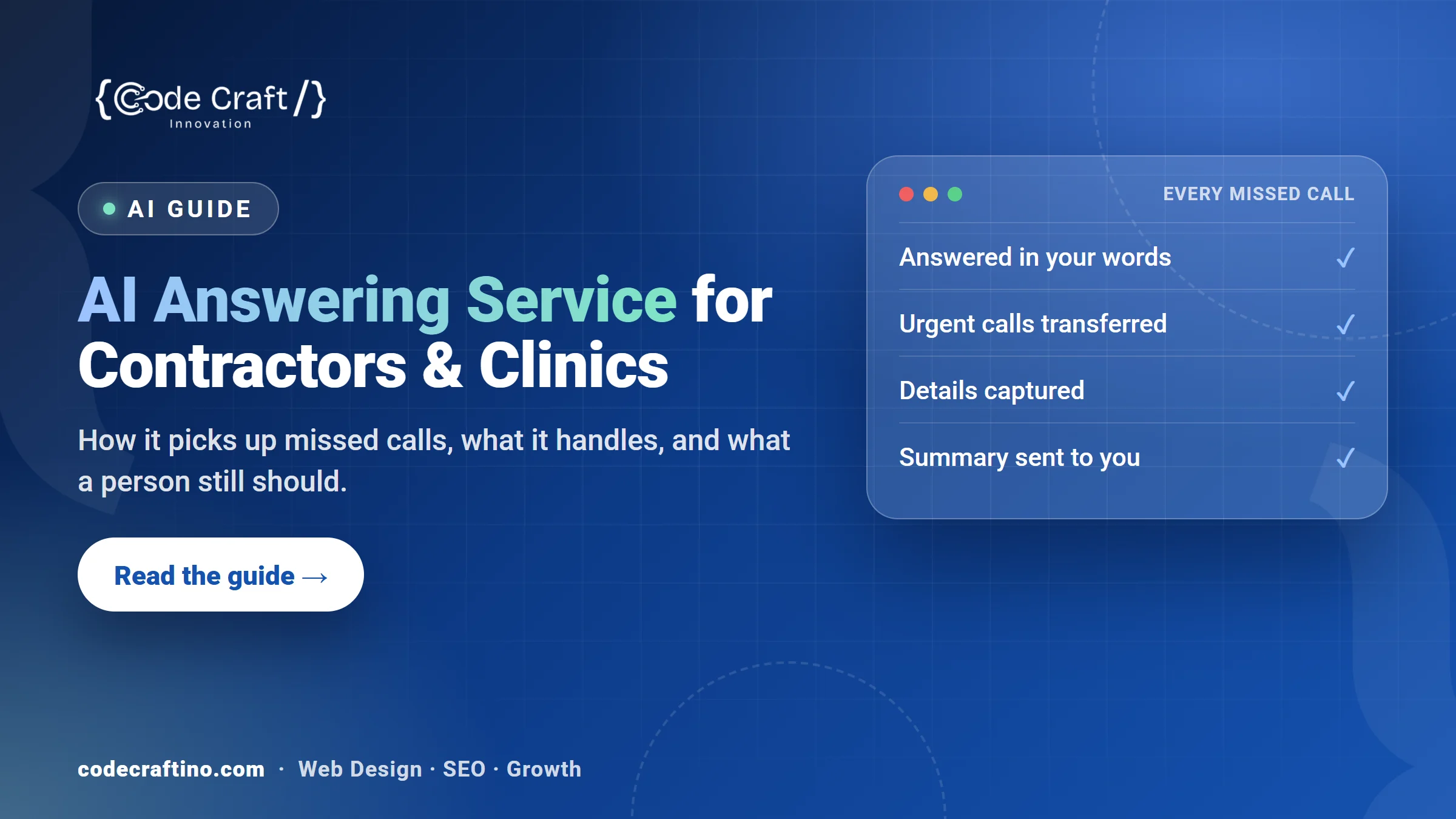
An AI answering service picks up the calls your team can’t, answers common questions in words you’ve approved, takes the details of a new job or appointment request, and sends them to you straight away, day or night. For a contractor that means fewer jobs lost while you’re on a roof or under a sink. For a clinic it means fewer patients sent to voicemail when the front desk is busy. This guide explains how an AI answering service works, what it should and shouldn’t handle for contractors and clinics, and what to check before you switch it on.
What is an AI answering service?
It’s a phone line that answers with an AI voice instead of a recording. When a call isn’t picked up by your team, it’s forwarded to the service. The AI greets the caller with your business name, understands what they need in normal speech, and follows the instructions you set: answer a question, collect details, offer an appointment request, or put the call through to a person.
The difference from voicemail is that the caller gets a conversation and an outcome. Most people who reach voicemail when they need a plumber or a dentist simply call the next name on the list.
How does an AI answering service work?
- Call forwarding. Your existing number stays the same. You choose when calls go to the service: always, after a set number of rings, when the line is busy, or only outside business hours.
- Greeting. The AI answers with your business name and tells the caller they’re speaking with an automated assistant.
- Understanding the request. The caller explains what they need in their own words, for example “my water heater is leaking” or “I need to move my appointment.”
- Following your script. It answers approved questions (hours, service area, what to bring), collects the details you need, and records an appointment or quote request.
- Handing off. Urgent calls are transferred to the person on call. Everything else arrives as a text or email summary with the caller’s name, number and request, and the call is logged.
You decide every answer it’s allowed to give. Anything outside those answers should go to a person, not to a guess.
What does an AI answering service do for contractors?
Contractors miss calls for one simple reason: the work happens away from the phone. An AI answering service covers that gap:
- Emergency triage. Calls about a burst pipe, no heat or a roof leak are recognized and transferred to whoever is on call, with the address already captured.
- Quote requests. It takes the job type, address, timing and the best number to call back, and can text the caller a link to send photos.
- Service area checks. It tells callers outside your area politely, so you don’t spend time calling back jobs you can’t take.
- After-hours calls. Evening and weekend enquiries are captured and waiting for you in the morning, instead of going to a competitor who answered.
Pair it with a website that makes calling and requesting a quote easy; our guide to contractor website design covers that side.
What does an AI answering service do for clinics?
For dental, medical and therapy practices, the busiest phone times are also the busiest front-desk times. An AI answering service can:
- Take appointment requests and cancellations, with the patient’s name, number and preferred times.
- Answer the questions you approve about hours, location, parking and what to bring to a first visit.
- Route prescription, billing and clinical questions to the right staff member instead of answering them.
- Tell callers who describe an emergency to hang up and call 911.
It should never give medical advice or interpret symptoms. Keep its job to scheduling, information you’ve approved and getting the right message to the right person.
Is an AI answering service the same as an AI receptionist?
The terms overlap. “Answering service” usually describes covering calls nobody picked up: answering, taking details and passing them on. “AI receptionist” usually means a wider front-desk role, such as booking straight into your calendar, sending reminders and answering on every call rather than only the missed ones. Many products do both. If you’re comparing prices, see what an AI receptionist costs; for a setup built around your business, see our AI receptionist service.
What should clinics check about HIPAA?
If the service will hear or store patient information, it handles protected health information for your practice. Under the HIPAA Privacy Rule, a covered entity may allow a business associate to create, receive, maintain or transmit protected health information on its behalf only if it obtains satisfactory assurance that the business associate will appropriately safeguard the information, and those assurances “must be documented through a written contract or other written agreement” (45 CFR 164.502(e)).
In practice: ask the vendor to sign a business associate agreement before any patient calls go through it, and ask where call recordings and transcripts are stored and for how long. This isn’t legal advice; check with your compliance adviser.
Can it call customers back automatically?
Be careful here. On February 8, 2024 the FCC adopted a ruling that “calls made with AI-generated voices are ‘artificial’ under the Telephone Consumer Protection Act,” which means they’re held to the same standards as other artificial or prerecorded voice calls, including consent rules for telemarketing (FCC announcement). Answering calls people make to you is a different situation from placing calls to them. If you want automatic callbacks with an AI voice, check the consent rules first; a text or a call from your team is often the simpler option.
What should a person still handle?
- Pricing conversations and anything that needs a judgment call.
- Complaints and upset customers.
- Clinical questions, test results and anything about a patient’s care.
- Any caller who asks for a person. Make sure that option is always one sentence away.
How do you set up an AI answering service?
- List your calls. Write down the ten reasons people call most often and what a good outcome looks like for each.
- Write the answers. Approve the exact wording for hours, service area, prices you’re happy to share and what happens next.
- Decide what’s urgent. Define which calls transfer to a person and who is on call when.
- Choose the hand-off. Text, email or your CRM, and who receives each type of message.
- Test it yourself. Call it as a customer would, including awkward calls, before it goes live.
- Review the first weeks. Read the call summaries and adjust the answers that caused confusion.
If the summaries should also land in your CRM or trigger a follow-up text, that’s a small automation on top; see what AI automation costs a small business.
AI answering for New Jersey contractors and clinics
Code Craft Innovations sets up AI answering and AI receptionists for small businesses from our office in Fairfield, NJ, for clients across the state, including Fairfield and Paterson. We map your calls with you, write and test every answer, set the transfer rules for urgent calls and connect the summaries to the tools you already use. See how our AI receptionist service works, or book a free AI consultation to see whether it fits your phone line.
Frequently asked questions
Will callers know they’re talking to AI?
They should. A good setup says so in the greeting and offers a person whenever the caller asks. Being upfront builds more trust than trying to sound human.
Do I need a new phone number?
No. You keep your number and forward unanswered or after-hours calls to the service, so nothing changes on your website, signs or Google Business Profile.
Can it book appointments directly?
It can if it’s connected to your calendar or booking system. Many clinics start with appointment requests that staff confirm, then move to direct booking once they trust it.
What happens with emergency calls?
You set the rules. For contractors, emergencies transfer to the person on call. For clinics, callers describing a medical emergency are told to call 911.
Can it handle calls in Spanish?
Many services support more than one language. Test it with real phrases your callers use before relying on it, and keep a person available for anything it doesn’t understand.



Share your thoughts