
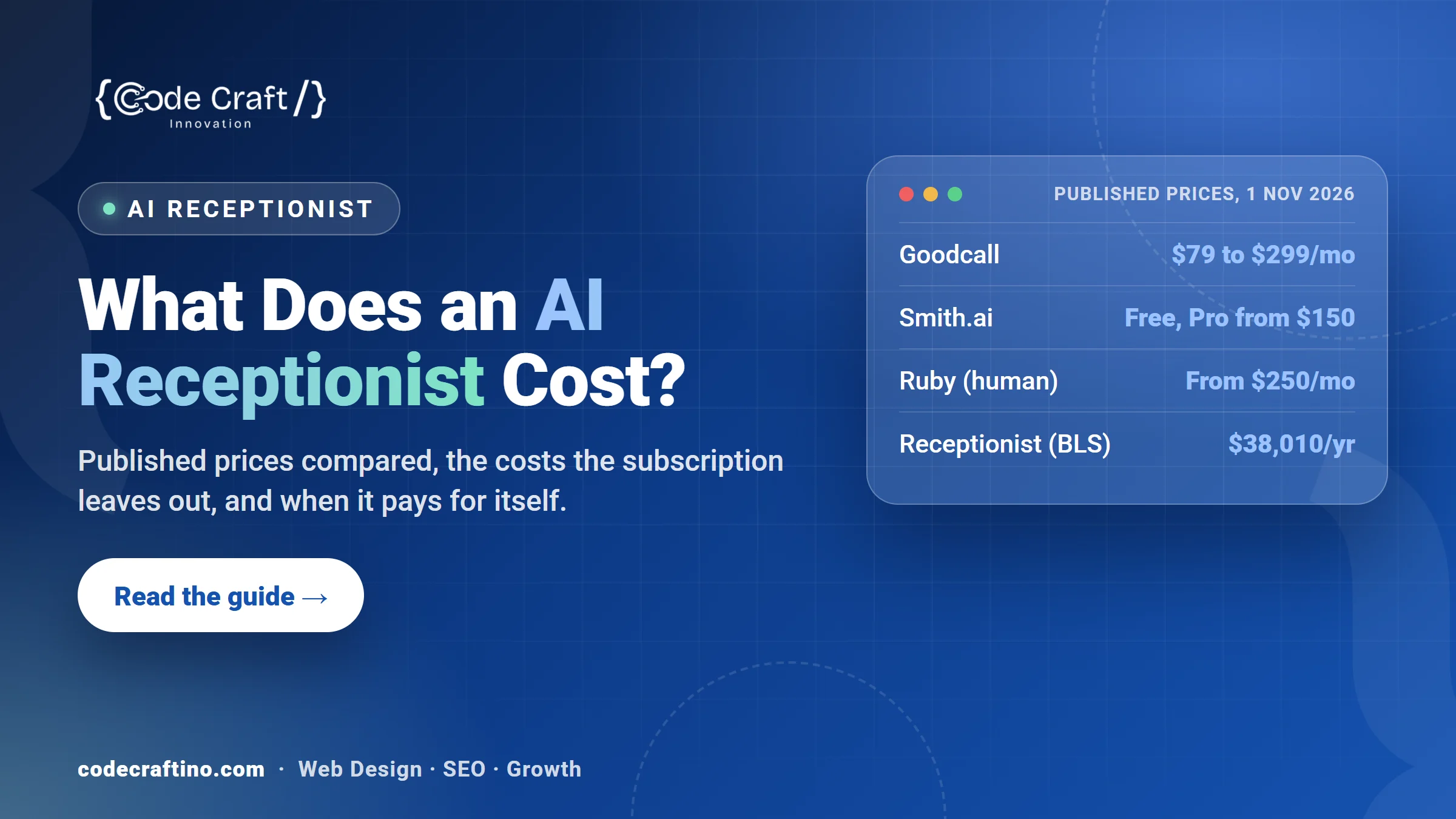
An AI receptionist for a small business usually costs between $0 and a few hundred dollars a month in subscription fees, depending on how many calls it handles. Published prices from the main providers show the range: Goodcall’s plans run from $79 to $299 a month, and Smith.ai offers a free AI plan with 25 calls a month and a Pro plan from $150 a month, charged per call. A live human answering service such as Ruby starts at $250 a month for 50 minutes. This guide explains what drives the price, what the subscription leaves out, and how to work out whether an AI receptionist pays for itself in your business.
What does an AI receptionist cost per month?
Most providers charge a monthly subscription plus a usage allowance. The allowance is measured in different ways, so compare plans on the number of calls you really get, not on the headline price. Here are the published prices from three well known providers, checked on 1 November 2026:
| Provider | Type | Published price | What the price includes |
|---|---|---|---|
| Goodcall | AI receptionist | $79, $129 or $299 a month | 100, 500 or 2,000 unique customers a month; extra customers at 79, 26 or 15 cents each; no per minute charges |
| Smith.ai | AI receptionist | Free, or Pro from $150 a month | Free plan: 25 calls a month; paid plans charge per real call, about $1.67 to $2.00 a call on the listed tiers |
| Ruby | Live human receptionists | From $250 a month | 50 minutes for $250, 100 for $395, 200 for $720, 500 for $1,725 |
Sources: Goodcall pricing, Smith.ai AI receptionist pricing and Ruby pricing. Prices change often, so check each page before you buy.
How does that compare with hiring a receptionist?
The U.S. Bureau of Labor Statistics puts the median pay for receptionists at $38,010 a year, or $18.27 an hour in May 2025 (BLS Occupational Outlook Handbook). That works out to about $3,170 a month in wages alone, before payroll taxes, benefits, holidays and cover for sick days.
The comparison isn’t only about money. A person on your front desk can greet walk-in clients, handle complicated or emotional calls and do other office work. An AI receptionist is strongest where people are hardest to cover: evenings, weekends, lunch breaks and the busy moments when every line is ringing. For many small businesses the right answer is both: your team during the day, with AI picking up whatever they can’t.
What drives the price up or down?
- Call volume: the biggest factor. Plans are priced by calls, minutes or unique callers, so estimate your monthly calls from your phone bill first.
- How the allowance is counted: per call, per minute or per unique caller. A business with short, repeat calls pays very differently under each model.
- Booking and integrations: booking straight into your calendar, sending details to your CRM or job software, and texting confirmations are often limited to higher plans.
- Hours of human backup: some services pass difficult calls to live agents, which usually costs more than AI alone.
- Setup and training: writing the greeting, the approved answers and the rules for urgent calls takes time, whether you do it or pay someone to do it.
What does the subscription leave out?
The monthly fee is rarely the full cost. Budget for these as well:
- Your time to set it up: listing your services, hours, service area, prices you’re happy to quote, and what should happen with urgent calls.
- Phone number changes: forwarding your existing number or porting it to the provider.
- Testing: calling it yourself with real questions before customers do, and listening to early calls.
- Ongoing updates: new services, holiday hours and seasonal changes need to be added, or the receptionist will give old answers.
- Follow up: an AI receptionist captures the enquiry; someone still has to call back, quote and close the job.
How do you work out if it pays for itself?
Use your own numbers. Four figures are enough:
- Missed calls a month: check your phone system or carrier for unanswered calls, especially after hours.
- Share that are new enquiries: not every missed call is a new customer. Estimate from the voicemails you do get.
- Your close rate: of the new enquiries you speak to, how many become paying jobs?
- Average job value: the typical first sale, or the lifetime value if clients come back.
Multiply missed new enquiries by your close rate and your average job value. That’s the revenue you’re currently letting go to voicemail. If even one recovered job a month covers the subscription, the decision is easy. If you rarely miss calls, an AI receptionist may not be worth it yet.
Which businesses get the most from an AI receptionist?
- Contractors and home services: plumbers, roofers, landscapers and electricians who are on a job when the phone rings. See our guide to digital marketing for home service businesses.
- Clinics and practices: dental, chiropractic and wellness practices with busy front desks and after hours calls.
- Law firms: new clients often call once and move on if nobody answers. Our guide to law firm websites covers the rest of the intake path.
- Venues and appointment based services: salons, studios and event spaces where most calls are about availability and booking.
What should you ask before you sign up?
- How is usage counted: calls, minutes or unique callers? What happens when I go over?
- Can it book into my real calendar, and which calendars and CRMs does it connect to?
- How does it hand an urgent or upset caller to a person, and how fast?
- Will it introduce itself honestly as a virtual receptionist?
- Where are call recordings and transcripts stored, and who can see them?
- Is there a contract term, a setup fee or a cancellation fee?
An AI receptionist is one part of a wider setup. If you want it to also follow up, update records or send quotes, read about AI automation for small businesses.
AI receptionists for New Jersey small businesses
Code Craft Innovations sets up AI receptionists for small businesses from our office in Fairfield, NJ, for clients across the state, including Fairfield and Montclair. The greeting, the business facts and the tone are approved by you before the first real call, it books from your live calendar, and any caller who needs a person is passed to your team with a full summary. Learn how our AI receptionist service works, or book a free AI consultation to see it answer a call for your business.
Wondering whether you need a chatbot or something that books the work too? Read AI agent vs chatbot.
Frequently asked questions
Is an AI receptionist cheaper than an answering service?
Usually, at the same call volume. Based on the published prices above, AI plans start lower than live answering services, which bill for human minutes. Live services still suit calls that need a person’s judgement.
Can an AI receptionist book appointments?
Many can, if they’re connected to your calendar. Check which calendars are supported and whether booking is included in the plan you’re comparing.
Will callers know they’re talking to AI?
A good setup introduces itself as the business’s virtual receptionist. Being honest up front builds trust, and callers who want a person should be able to reach one.
How long does it take to set up?
It depends on how much information the receptionist needs and how many systems it connects to. Writing and approving the answers is usually the longest step.
Can I keep my current phone number?
Usually, yes. Most services work by forwarding calls from your existing number, so customers keep calling the number they already know.



Share your thoughts