
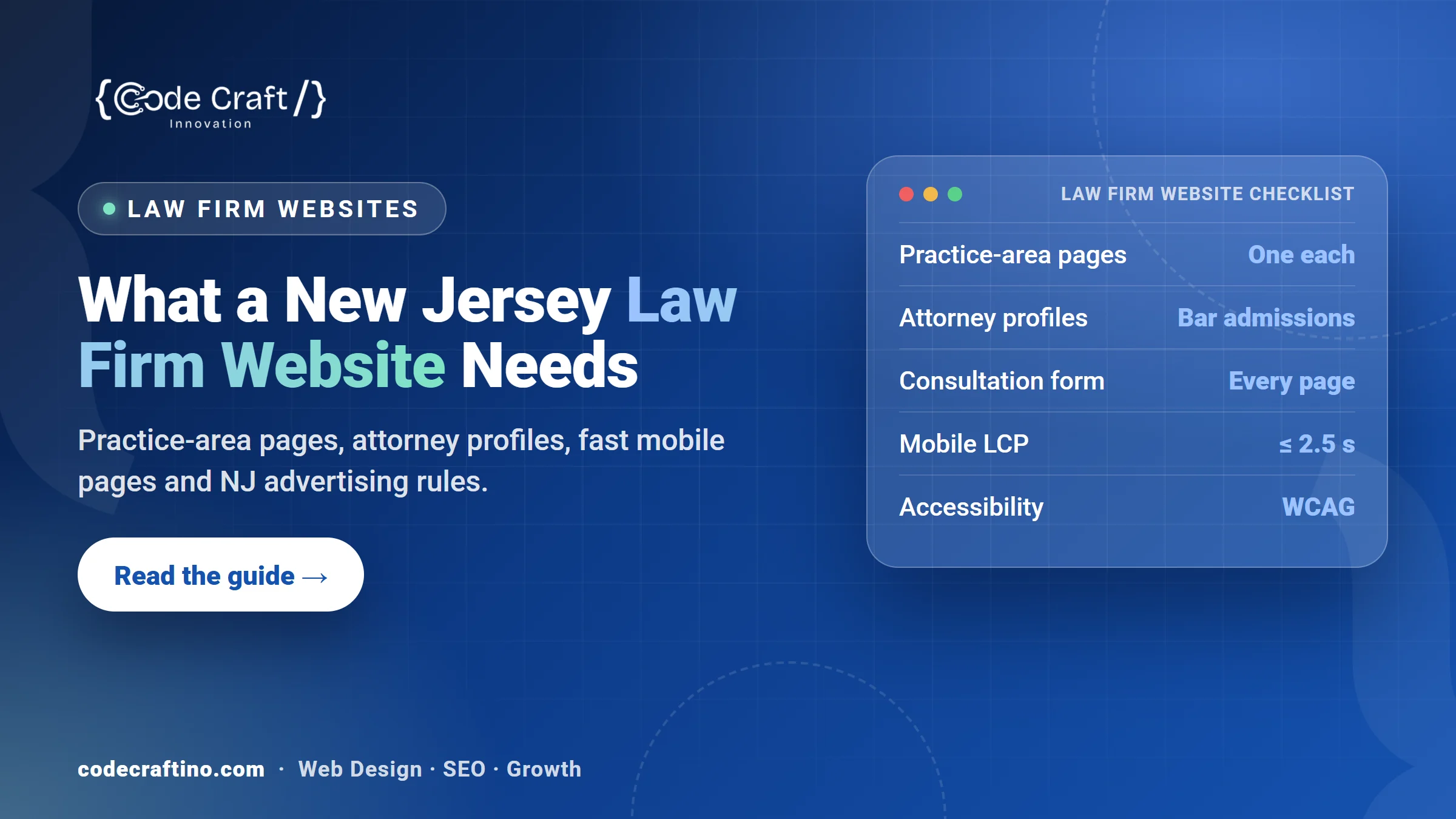
A law firm website has one job: turn someone with a legal problem into a consultation request. To do that it needs a separate page for each practice area, real attorney profiles, a short consultation form and phone number on every page, fast loading on a phone, and content that follows New Jersey’s attorney advertising rules. This guide covers what a New Jersey law firm’s website should include, the rules that shape it, and what to check before you pay for a redesign.
What should a law firm website include?
People looking for a lawyer usually search for a specific problem in a specific place, such as “divorce lawyer Morristown” or “slip and fall attorney Newark”. Your site should answer that search and make the next step easy. A useful law firm website has:
- One page per practice area: family law, personal injury, real estate closings, estate planning and so on, each with its own title, explanation and consultation button.
- Attorney profiles: a real photo, bar admissions, education, the practice areas each attorney handles, and how to contact them.
- Contact options on every page: a click-to-call phone number, office address and hours, and a short consultation form.
- Proof of experience: client reviews and descriptions of the kinds of matters you handle, presented within the advertising rules covered below.
- Local information: each office address, the courts and counties you work in, and directions or parking notes.
- Fast, mobile-friendly pages: many people search for a lawyer on their phone, often in a stressful moment.
Why does each practice area need its own page?
Because each one is a different search with a different client. Someone facing a DUI charge and someone buying a house in Montclair won’t type the same words, and Google ranks pages, not whole websites. A single “Our Services” page that lists ten practice areas in one paragraph rarely ranks for any of them.
A good practice-area page explains the type of matter in plain English, what the process usually looks like, what the client should bring to a first meeting, and which attorney handles it. Add a few questions clients really ask, with short answers, and a clear call to book a consultation.
This is the approach we used for Coluccio Law, a WordPress site for a law firm in Washington State: in-depth pages for each practice area, attorney profiles, reviews, legal and local business schema, and a consultation request on every page. The Coluccio Law case study shows the full project and results.
What New Jersey advertising rules apply to a law firm website?
Your website is a communication about your services, so the Rules of Professional Conduct apply. RPC 7.1(a) starts with a simple principle: a lawyer “shall not make false or misleading communications about the lawyer, the lawyer’s services,” or any matter the lawyer is involved in. In practice that affects how you describe past results, awards, comparisons with other firms and any certification.
The rules also reach online advertising. In May 2025, the New Jersey Supreme Court held that buying a competitor’s name as a search keyword doesn’t by itself violate the RPCs, but it now requires a disclaimer on any landing page the paid ad leads to. That disclaimer states that the visitor arrived through a paid advertisement on the named search engine, and that the website is affiliated only with the purchasing attorney (In re Opinion No. 735, Supreme Court of New Jersey).
We build the pages, but we don’t give legal advice. Have your ethics counsel or the attorney responsible for advertising review the wording of results, testimonials and awards before launch.
How should attorneys appear on Google Maps?
Your firm’s Google Business Profile is often the first thing a local client sees. Google’s guidelines allow an individual practitioner, such as a lawyer, to have their own profile if they’re in a public-facing role and can be contacted directly at the verified location during stated hours. If one attorney is the only public-facing practitioner at a branded firm, Google recommends sharing one profile named in the format “[firm name]: [attorney name]” (Google Business Profile guidelines).
Each profile should link to the matching attorney or office page on your website, and the name, address and phone number should match exactly. Our Google Business Profile checklist covers the setup step by step.
Does a law firm website need to be accessible?
Yes, and law firms should take it seriously. The U.S. Department of Justice’s web accessibility guidance (March 18, 2022) says Title III of the ADA prohibits discrimination against people with disabilities by businesses open to the public, and that the ADA’s requirements apply to the goods and services these businesses offer on the web. It points to the Web Content Accessibility Guidelines (WCAG) as helpful technical standards (ADA.gov).
In practice: readable text contrast, headings in the right order, alt text on images, forms that work with a keyboard and screen reader, and captions on videos.
How fast should a law firm website load?
Google’s Core Web Vitals give clear targets. A page is “good” when its main content loads within 2.5 seconds, it responds to taps within 200 milliseconds, and its layout shift score is 0.1 or less (web.dev). Large stock photos of courthouses, video headers and chat widgets that load on every page are the usual reasons law firm sites miss these targets.
How should the consultation form work?
- Keep it short: name, phone, email, practice area and a brief description.
- Ask people not to include confidential details in the first message, and say that submitting the form doesn’t create an attorney-client relationship.
- Send every enquiry to a monitored inbox and, ideally, a CRM, and test it after every website change.
- Track form submissions and calls in Google Analytics so you know which pages and searches bring clients.
- Tell people what happens next and how quickly you’ll respond.
Should a law firm use WordPress?
For most small and mid-sized firms, yes. WordPress makes it easy to add practice-area pages, attorney bios and articles without a developer, and it works well with SEO plugins and schema. The real choice is between a theme and a custom design; our guide on custom WordPress vs a theme explains the trade-offs. For budgets, see how much a website costs in New Jersey.
What should you check before a law firm website redesign?
- Which pages already bring visitors and calls (Google Search Console and Google Analytics), so you keep them and redirect old URLs.
- Whether every practice area and office has its own page.
- Whether attorney bios are complete and up to date.
- Whether the contact form actually delivers enquiries today.
- Who will review the wording against the advertising rules.
Law firm websites for New Jersey firms
Code Craft Innovations designs and builds law firm websites from our office in Fairfield, NJ, for firms across the state, including Newark and Jersey City. We plan the practice-area pages, write or edit the content with your attorneys, set up local SEO and tracking, and hand over a site your team can update. Learn more about our WordPress development services or tell us about your firm and you’ll get a fixed written quote within 24 hours.
Frequently asked questions
How many pages does a law firm website need?
At least a home page, one page per practice area, one profile per attorney, an about page, a contact page with each office, and a few articles that answer common client questions. A firm with six practice areas and three attorneys usually starts with 15 to 20 pages.
Can we show past case results on our website?
Possibly, but New Jersey’s rule against false or misleading communications (RPC 7.1) applies, so have the wording reviewed by your ethics counsel before you publish results or testimonials.
How long does it take to build a law firm website?
It depends on the number of pages and how quickly content is approved. Content review by attorneys is often the longest step. Our guide on how long it takes to build a business website explains each stage.
Should each attorney have their own page?
Yes. Clients want to know who they’ll work with, and many people search for an attorney by name before they call. Link each page from the practice areas that attorney handles.
Do we need a blog?
Not a busy one, but a few clear articles that answer the questions clients ask before hiring a lawyer help both search rankings and trust. Quality and accuracy matter more than frequency.






Share your thoughts